Have you ever downloaded an eBook, purchased an online course, or streamed software? If so, you’ve already bought a digital product, and you probably didn’t even think twice about it. But what if I told you that digital products are also one of the most exciting, low-cost ways to start a side hustle and earn money online?
In this post, I’m going to break down exactly what digital products are, why they’re brilliant for beginners, and walk you through the most popular types so you can start thinking about which one might be right for you.
So, What Exactly Are Digital Products?
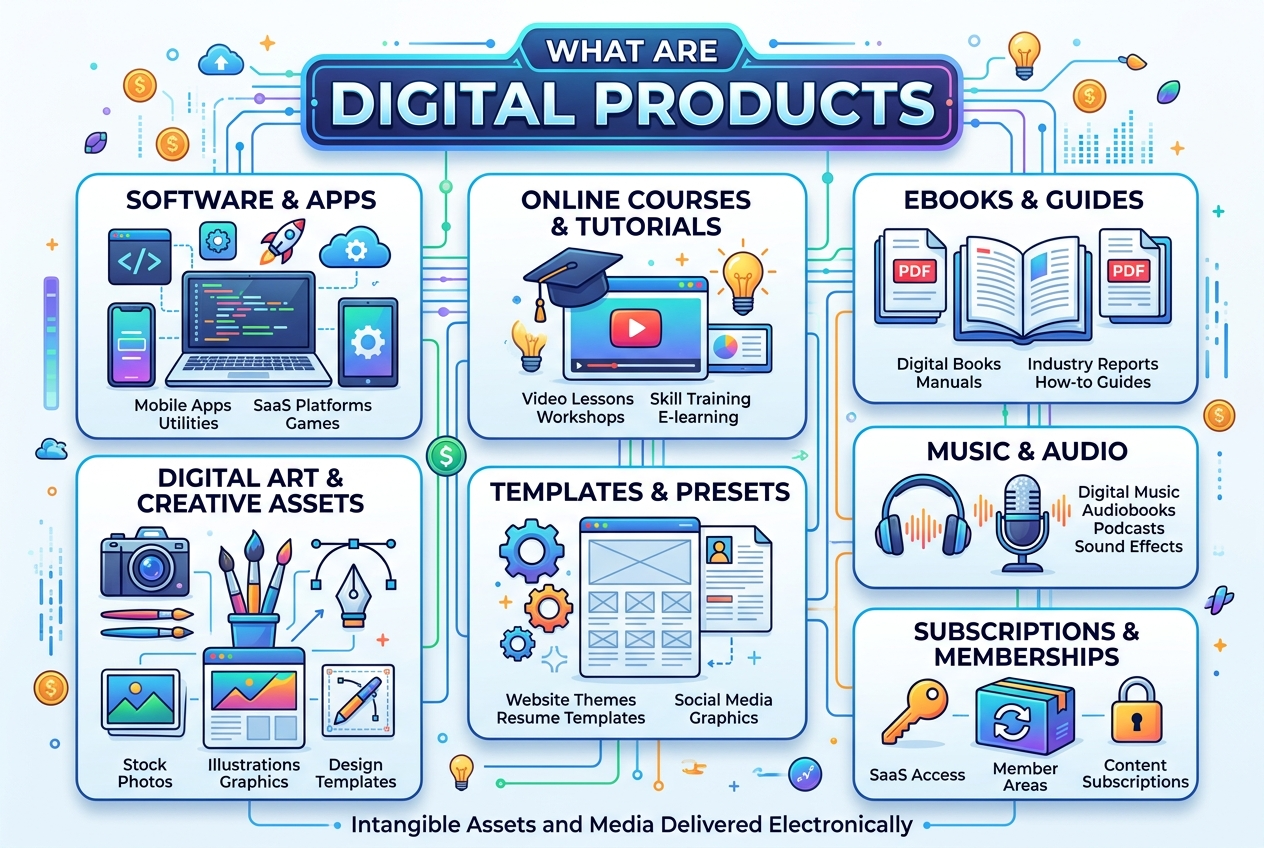
A digital product is an intangible good that exists purely in digital format, meaning you can’t hold it in your hands, but it’s 100% real and valuable. Unlike physical products, there’s nothing to manufacture, package, or post.
Digital products are delivered either via download (instantly, the moment you purchase) or via email (a link or file sent straight to your inbox). That’s the beauty of them, they’re available 24 hours a day, 7 days a week, anywhere in the world.
Some classic examples include:
- eBooks – digital books you read on a device
- Music – tracks, albums, and sound files
- Digital art – illustrations, graphics, and designs
- Software – apps, tools, plugins, and programmes
- Online courses – structured learning delivered via video, audio, or text
- Virtual goods – in-game items, digital templates, Canva designs, and more
And here’s the bit that makes your ears prick up as a budding side hustler: once you’ve created a digital product, you can sell it again and again, without any additional cost. That’s what we call passive income potential, and it’s genuinely life-changing.
Why Digital Products Are Perfect for Side Hustles
Before we get into the types, let me quickly explain why digital products are such a cracking option for anyone looking to earn extra money:
✅ No stock to hold – Everything lives in the cloud
✅ High profit margins – Keep the vast majority of every sale
✅ Scalable – Sell to one person or ten thousand for the same effort
✅ Passive income potential – Earn while you sleep
✅ Global reach – Sell to customers anywhere in the world
✅ Beginner-friendly – You don’t need to be a tech whizz to get started
But these points deserve a much bigger conversation, because the benefits of running a digital product business go far deeper than a quick bullet list. Let’s break them down properly.
The Real Benefits of Starting a Digital Product Business
If you’ve ever run, or even just thought about running, a traditional product-based business, you’ll know it comes with a mountain of headaches. Stock to manage. Suppliers to chase. Postage costs are eating into your margins. Returns to deal with. And all before you’ve even made your first sale.
A digital product business flips all of that on its head. Here’s why it’s genuinely one of the most beginner-friendly business models out there.
1. No Stock to Buy, Store, or Manage
This is the big one. With a physical product business, you’ve got to buy stock before you can sell it, which means money out of your pocket before a single customer comes through the door. Then there’s the question of where to store it. Your spare room? A rented storage unit? A warehouse?
With digital products, none of that exists. Your product is a file. It lives on a server. Once it’s created, it costs you nothing to store and nothing to duplicate. You don’t need a garage full of boxes, a van, or a relationship with a courier company.
A physical product seller might spend £2,000 buying stock before making a single sale. A digital product creator can start with nothing but their laptop and an internet connection.
2. Exceptionally High Profit Margins
In traditional retail, profit margins can be very low, especially once you’ve factored in the cost of goods, postage, packaging, returns, and marketplace fees. Many physical product sellers on Amazon or eBay are left with margins of 10–30% if they’re lucky.
Digital products are a completely different story. Once your product is created, your only ongoing costs are typically:
- Platform fees (e.g. Gumroad takes 10%, Etsy charges a small listing and transaction fee)
- Payment processing fees (usually around 2–3%)
- Marketing costs (optional, and often free if you use social media)
That means on a £47 eBook, you could realistically keep £38–£42 of every sale. On a £297 online course sold through your own website? You could keep well over 90% of every sale. That’s a profit margin most traditional business owners can only dream of.
3. Create Once, Sell Indefinitely
This is the concept that blows people’s minds when they first hear it, and it’s completely true. When you write an eBook, record an online course, or build a software template, you do that work once. After that, every single sale is essentially effortless.
Compare that to a service-based business, where you trade your time for money every single day. Finish the work, get paid. Stop working, stop earning.
With digital products, the work and the income become completely uncoupled. You might spend two weekends creating an eBook in January, and still be earning from it in December without lifting a finger.
This is what people mean when they talk about “passive income.” It’s not completely hands-off forever, you’ll still want to market your products, but the income-per-hour ratio is dramatically better than almost any other business model.
4. Sell to Anyone, Anywhere in the World (Global Business From Day One)
Your local market is limited. Your online market is not. With a digital product business, your potential customer base is every person on the planet with an internet connection and a bank card. You have a global business from day one.
Someone in Sydney could buy your eBook at 2am UK time. A small business owner in Canada could enrol in your online course at the weekend. A freelancer in Berlin could download your template pack on a Tuesday afternoon.
You don’t need a physical shop, a local following, or even a presence in a particular city. Your digital storefront is open 24 hours a day, 7 days a week, 365 days a year.
5. Incredibly Low Start-Up Costs
Starting a traditional business can cost thousands of pounds before you’ve sold a single thing. A digital product business? You can genuinely start for free, or very close to it.
Here’s what a typical digital product launch might cost:
| What You Need | Free Option | Paid Option |
|---|---|---|
| Create your product | Google Docs, Canva (free) | Adobe, Notion — from £5 per month |
| Sell your product | Gumroad (free plan), Payhip (free plan) | Shopify — from £19 per month |
| Market your product | Instagram, TikTok, Pinterest (all free) | Paid ads — your choice |
| Email list | Mailchimp (free up to 500 subscribers) | BirdSend — from £9 per month |
You could have your first digital product live and for sale by the end of this week, having spent nothing at all. Try doing that with a café or a clothing brand.
6. Instant Delivery – Happy Customers, Zero Effort
When someone buys a physical product, they often have to wait days or even weeks for it to arrive. That’s a gap where things can go wrong: lost parcels, damaged goods, delivery delays, and frustrated customers firing off emails.
With digital products, delivery is instant. The moment a customer pays, they receive their download link or access details, automatically, without you doing a single thing. No trips to the post office. No bubble wrap. No “sorry, it must have got lost in the post” conversations.
This also means no returns in the traditional sense. Most digital product sellers have a simple no-refund policy (which is standard and accepted in the industry), which means you’re not constantly processing returns and chasing refunds like a physical product business often has to.
7. Easy to Scale Without Extra Costs
In most businesses, growth means more costs. Hire more staff. Buy more stock. Rent a bigger space. The more you sell, the more you spend.
Digital products break this model entirely. Whether you sell 10 copies of your eBook or 10,000 copies, your costs stay almost exactly the same. The file doesn’t change. The server doesn’t care. Scaling a digital product business doesn’t require investment, it just requires better marketing.
This is what makes digital products so powerful for side hustlers who want to grow at their own pace. You can start small, test what works, and scale up when you’re ready, without needing to take out a loan or remortgage your house.
8. Work From Anywhere, on Your Own Terms
A digital product business doesn’t tie you to a desk, a shop, or a specific city. As long as you have a laptop and Wi-Fi, you can run your entire business from a café in Edinburgh, a beach in Tenerife, or your kitchen table in your pyjamas.
For people working a 9-to-5, this flexibility is everything. You can check your sales dashboard on your lunch break, respond to customer emails in the evening, and create new products at the weekend, all without your business ever demanding that you “be somewhere” at a specific time.
9. Low Risk – You’re Not Betting the House
One of the biggest fears people have about starting a business is the risk of losing money. And it’s a legitimate concern, many traditional businesses fail within the first year, often because of high fixed costs and slow initial sales.
With a digital product business, your financial exposure is tiny. If your first product doesn’t sell well, you haven’t lost thousands, you’ve lost a few hours of your time and perhaps the cost of a Canva subscription. You can pivot, try a different niche, or improve the product without financial disaster.
This low-risk entry point is one of the main reasons digital products are the go-to recommendation for anyone who wants to start a side hustle without gambling their savings.
10. Build a Business Around Your Expertise
Here’s something a lot of people overlook: you already have knowledge, skills, and experience that other people would pay to access. The years you’ve spent in your career, your hobbies, your life experiences, all of that has value.
Digital products give you a way to package that expertise and monetise it. You don’t need to be the world’s leading expert. You just need to know more than the person you’re selling to, and be able to explain it clearly.
A nurse could create a course on stress management. A parent could write an eBook on raising confident children. A decorator could build a template pack for client quotes. The knowledge is already there, digital products just give it a commercial outlet.
Types of Digital Products (With Real Examples)
1. eBooks
An eBook is simply a book in digital format, typically a PDF. They’re one of the easiest digital products to create, and they can cover any topic under the sun.
Example: If you’re brilliant at budgeting, you could write a 30-page eBook called “The UK Side Hustler’s Guide to Managing Your Money” and sell it for £9.99 on Gumroad or Etsy.
Top tip: You don’t need to be a published author. If you know something others want to learn, that’s enough to write an eBook.
2. Audiobooks
An audiobook is the audio version of a written book, recorded and delivered as an MP3 or similar file. The audiobook market is booming, and creators are cashing in.
Example: Record yourself reading your own eBook, edit it in free software like Audacity, and sell it as a bundle alongside the written version for a higher price point.
3. Software & Apps
Software products range from full-blown applications to simple browser extensions, plugins, and tools. If you have coding skills (or can work with a developer), this can be incredibly lucrative.
Example: A simple Notion template, a WordPress plugin, or a Chrome extension that saves people time in their day-to-day lives.
Top tip: You don’t need to code everything yourself. Tools like Bubble and Glide allow you to build apps with no code at all.
4. Online Courses
Online courses are structured learning programmes delivered digitally, usually via video lessons, PDFs, and quizzes. This is one of the biggest and fastest-growing digital product markets in the world.
Example: A 5-module course on “How to Start a Cleaning Business in the UK” sold via Teachable or Kajabi for £97–£297.
5. Information Products
These are digital downloads packed with useful, actionable information, such as checklists, templates, spreadsheets, swipe files, and guides. They’re quick to create and easy to sell.
Example: A “Social Media Content Calendar Template” for small business owners, sold as a Google Sheet or Excel file for £7–£19. “How to” guide which can sell for anything between £7- £497+
6. Affiliate Products & Services
Affiliate marketing is slightly different, instead of creating a product, you promote someone else’s product and earn a commission on every sale. It’s a brilliant way to start earning online without creating anything yourself.
Example: Sign up to the Amazon Associates Programme or ClickBank, recommend products you genuinely use and love, and earn a percentage of every sale through your unique link.
7. Marketing Services & Packages
If you’ve got skills in social media management, copywriting, SEO, or graphic design, you can package these up as a digital service and sell them online.
Example: A “Done-For-You Instagram Content Package” – 30 posts, captions, and a content strategy delivered as a ZIP file, sold for £150–£500 per month.
8. AI Products
The AI revolution is here, and savvy side hustlers are already creating AI-powered digital products, from custom ChatGPT prompts to AI-generated art packs and AI workflow automation templates.
Example: A bundle of 100 ChatGPT prompts for small business owners, sold as a PDF for £12.99. Or a set of Midjourney prompt templates for interior designers.
Top tip: AI products are one of the hottest niches right now. Get in early!
9. Coaching & Mentoring
Coaching and mentoring programmes are considered digital products when delivered online, via Zoom calls, email support, or membership communities. You’re selling your knowledge and time in a structured, repeatable way.
Example: A 4-week “Launch Your Side Hustle” 1:1 coaching programme delivered entirely via Zoom and email, sold for £497.
Top tip: You don’t need fancy qualifications to coach someone. You just need to be a few steps ahead of the person you’re helping.
10. Webinars
A webinar is an online seminar, live or pre-recorded, where you teach, present, or discuss a topic with your audience. Webinars are fantastic for building trust, growing your email list, and selling your other digital products.
Example: A free 60-minute webinar called “5 Digital Products You Can Create This Weekend” used to warm up your audience before pitching your paid online course.
How Are Digital Products Delivered?
Most digital products are delivered in one of two ways:
- Instant Download: The customer pays, clicks a button, and the file is downloaded immediately. Platforms like Gumroad, Payhip, and Etsy handle this for you automatically.
- Email Delivery: After purchase, the customer receives an email with a link or attachment to access their product. This is common for courses, coaching programmes, and software licences.
Where Can You Sell Digital Products?
Here are some of the most popular platforms for UK side hustlers:
Platforms and Best For:
Gumroad: Best for eBooks, templates, music, art
Etsy: Best for Digital downloads, printables
Teachable/Kajabi: Best for Online courses and memberships
Payhip: Best for an all-in-one digital store
Shopify: Best for building your own digital shop
Amazon KDP: Best for eBooks and audiobooks
Is Selling Digital Products Worth It?
Absolutely, but let me be honest with you. It’s not a get-rich-quick scheme. You’ll need to put in the effort up front to create something genuinely valuable. But once it’s done?
You could wake up tomorrow morning to a notification that says someone just bought your eBook at 3am, while you were fast asleep. That is the power of digital products.
Many successful UK side hustlers started with a single eBook or template and grew it into a full-time income. The key is to start, learn as you go, and keep improving.
Ready to Get Started?
Here’s your action plan:
- Pick one type of digital product that excites you
- Think about a topic or skill you know well
- Research what’s already selling on Etsy or Gumroad in that niche
- Start creating, even a rough first draft is better than nothing!
Digital products are one of the most accessible and exciting ways to start a side hustle in today’s world. Whether you fancy writing an eBook, building an online course, or jumping into the AI products space, there’s something here for everyone, regardless of your budget or experience level.
The best part? You can start this weekend. No fancy office, no big investment, no experience required.