
Starting a side hustle around what you love can transform your weekends from mundane to meaningful. Whether you’re an ambitious professional, a creative soul, or simply someone tired of trading time for money in a job that doesn’t spark joy, this post is for you.
You’ll discover how to identify your authentic passions and turn them into real income streams. We’ll walk through creating a solid business model that actually works, show you how to build your passion project without burning out from your day job, and cover the biggest challenges that trip up passion-based businesses in the UK. You’ll also learn how to scale your side hustle into income you can genuinely count on.
Your passion could be your next paycheck — let’s make it happen.
 Identify Your True Passions and Skills
Your passion isn’t always obvious, even to yourself. You might think you know what drives you, but it’s worth digging deeper. Pay attention to what makes you lose track of time. When do you feel most alive? What activities make you forget to check your phone? These moments reveal your authentic interests far better than any career assessment ever could.
Start by examining your daily habits and preferences. What topics do you research in your free time? Which YouTube rabbit holes do you fall into? What conversations make you more animated and engaged? Your browsing history and social media engagement patterns often reveal hidden passions you haven’t fully acknowledged yet.
Create a passion inventory by tracking your energy levels throughout different activities over a fortnight. Note when you feel drained versus energised. You’ll likely discover patterns that surprise you. Maybe you assumed you hated numbers, but tracking your fitness progress actually excites you. Perhaps you never considered yourself creative, but planning dinner parties brings you genuine joy.
Don’t dismiss activities just because they seem “too simple” or “not business-worthy.” Your passion for organising could become a professional organising service. Your love of explaining complex topics might translate into content creation or tutoring. Every genuine interest has potential business applications if you approach it creatively.
Assess Your Natural Talents and Acquired Expertise
Your skills fall into two categories: natural talents you’ve always possessed, and expertise you’ve developed through experience. Both are valuable, but they serve different purposes in your side hustle journey.
Natural talents often feel effortless to you but impressive to others. You might not even recognise them because they come so easily. Ask friends and colleagues what they think you’re naturally good at their outside perspective often reveals strengths you take for granted. Maybe you’re the person everyone comes to for advice, or you have an uncanny ability to spot design flaws, or you can explain complicated concepts in plain English.
Your acquired expertise represents years of learning and practice. This includes your formal education, professional experience, qualifications, and skills you’ve developed through hobbies. Don’t undervalue expertise gained outside traditional settings. Self-taught coding skills are just as valuable as a computer science degree. Years of managing family finances can translate into bookkeeping expertise.
Make two lists: your natural abilities and your learned skills. Then identify where these overlap with your passions. The sweet spot for your side hustle lives at this intersection. You want something you’re naturally drawn to and already good at, or can become good at quickly.
Consider both hard and soft skills. Technical abilities like graphic design or data analysis are obvious business assets. But soft skills like active listening, conflict resolution, or project management are equally valuable and often more transferable across different passion areas.
Evaluate Market Demand for Your Passion Areas
Your passion means nothing for business purposes if nobody wants to pay for it. This reality check isn’t meant to crush your dreams, it’s meant to help you find viable paths forward.
Start with basic market research. Are people already spending money in your passion area? Look for existing businesses, courses, products, or services related to your interests. If you find a thriving market, that’s good news — competition means demand exists. Your job becomes finding your unique angle within that space.
Use keyword research tools to see what people search for online. Google Trends shows whether interest in your topic is growing or declining. Social media platforms reveal what questions people ask and what content performs well. You can also check AnswerThePublic to see exactly what UK audiences are curious about in your niche.
Check job boards and freelance platforms like PeoplePerHour and Fiverr for opportunities in your passion area. Even if you don’t want traditional employment, these listings reveal what skills people value and what they’re willing to pay for.
Talk to potential customers directly. Join online communities, attend local meetups, or have informal conversations with people who might benefit from your passion-based service or product. Their pain points and willingness to pay for solutions will guide your business development.
Match Personal Interests with Profitable Opportunities
The final step combines everything you’ve discovered into actionable business ideas. You need the overlap between what you love, what you’re good at, and what people will pay for.
Create a simple matrix with your passions on one axis and market opportunities on the other. Look for intersections that score high on both personal satisfaction and profit potential. You might discover that your love of vintage clothing could become a reselling business on Vinted or eBay, or that your passion for helping others could translate into coaching services.
Consider different business models for each passion area. If you love photography, you could offer portrait services, sell stock photos via Shutterstock or Adobe Stock, teach photography workshops, or create digital products. Each model has different requirements, profit margins, and time commitments. Choose the one that aligns with your goals and lifestyle.
Test your ideas on a small scale before committing fully. Offer your services to friends, create a minimal viable product, or set up a simple online presence. This testing phase reveals whether your passion-profit combination works in practice, not just on paper.
Remember that profitable doesn’t always mean maximum profit. Factor in your personal satisfaction, work-life balance goals, and long-term vision. A moderately profitable passion project that energises you beats a highly profitable venture that drains your soul.
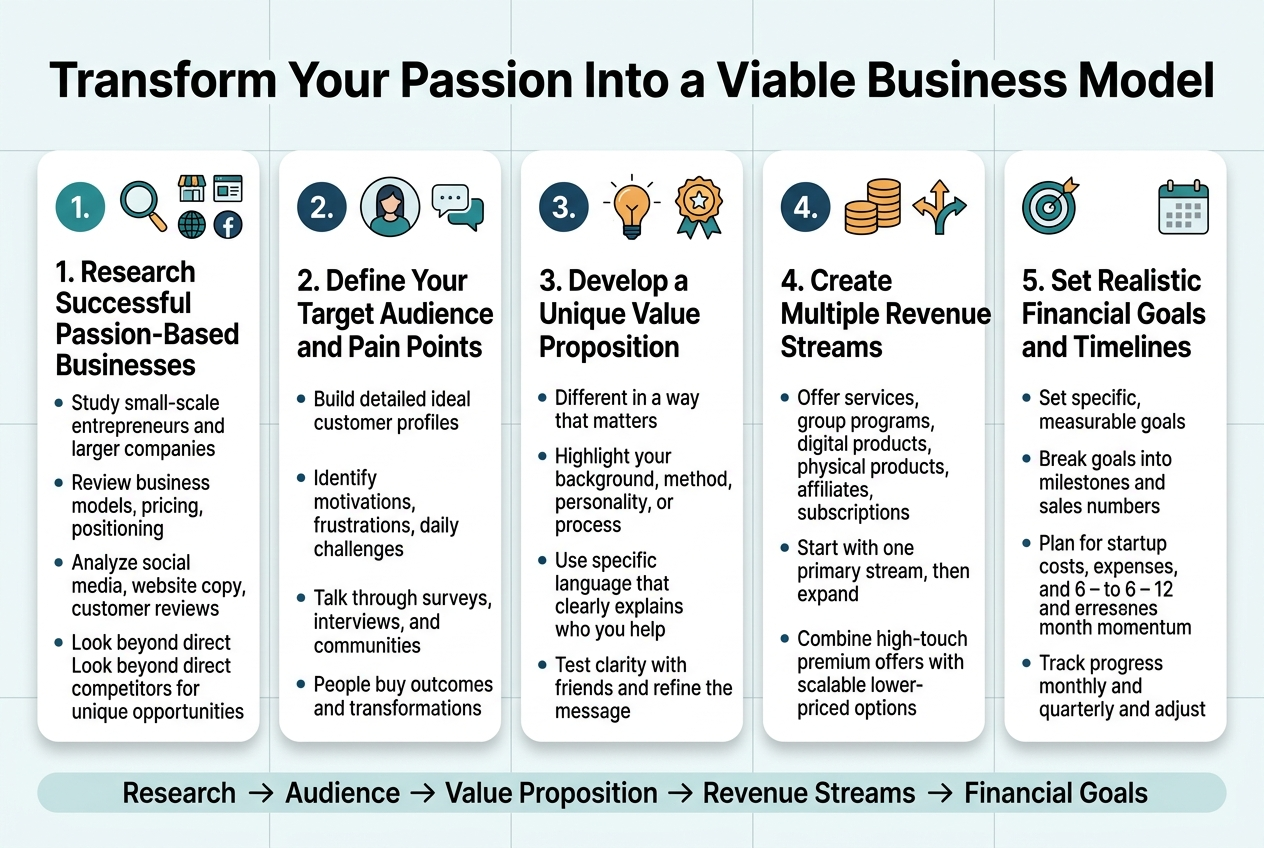
Research Successful Passion-Based Businesses in Your Niche
Start by diving deep into businesses that have successfully monetised the same passion you’re pursuing. Study both small-scale entrepreneurs and larger companies to understand the full spectrum of possibilities. Look at their business models, pricing strategies, and how they position themselves in the market.
Check out their social media presence, website copy, and customer reviews to understand what resonates with their audience. Pay attention to the problems they’re solving and how they communicate their value. You’re not looking to copy their approach, you’re looking to understand what’s working and what gaps you might fill.
Don’t limit yourself to direct competitors. If you’re passionate about photography, look at wedding photographers, stock photo businesses, online course creators, and photography equipment reviewers. Each represents a different way to turn the same passion into profit.
Define Your Target Audience and Their Pain Points
Your passion might excite you, but your business needs to solve real problems for real people. You need to get crystal clear about who you’re serving and what keeps them up at night.
Create detailed profiles of your ideal customers. Go beyond basic demographics and dig into their motivations, frustrations, and daily challenges. What are they struggling with that relates to your passion area? Where do they currently turn for solutions, and why are those solutions falling short?
Talk to people directly through surveys, social media conversations, or informal chats. Join UK-based online communities — Reddit UK and niche Facebook Groups are great places to listen to your potential customers’ language and understand their world. The words they use to describe their problems will become the words you use to describe your solutions.
Remember: people don’t buy products or services — they buy outcomes and transformations. Your job is to connect your passion with the specific outcomes your audience desperately wants.
Create Multiple Revenue Streams from Your Passion
Smart passion-based businesses don’t rely on just one way to make money. You want to build multiple revenue streams that complement each other and provide stability.
Think about the different ways you can package and deliver value. You might offer one-to-one services, group programmes, digital products, physical products, affiliate partnerships, or subscription-based offerings. Each serves different customer needs and price points.
Start with one primary revenue stream to validate your concept, then gradually add others. For example, if you’re passionate about fitness, you might begin with personal training, then add group classes, nutrition guides, online courses, and fitness equipment recommendations via affiliate programmes.
Consider both high-touch, premium offerings and scalable, lower-priced options. Platforms like Etsy and Not On The High Street are brilliant for UK makers and creatives who want to sell physical or digital products alongside their service offering.
Set Realistic Financial Goals and Timelines
Your enthusiasm is valuable, but it needs to be grounded in realistic expectations. Set specific, measurable financial goals with clear timelines — but make sure they’re achievable given your current situation and resources.
One important thing to be aware of as a UK side hustler: you have a £1,000 trading allowance from HMRC each tax year, meaning you can earn up to this amount from self-employment without needing to declare it. Once you exceed this, you’ll need to register for Self Assessment and pay tax on your profits. It’s worth getting your head around this early — HMRC’s guidance makes it straightforward.
Break down your goals into smaller milestones. Instead of just saying “I want to earn £500 a month,” map out how you’ll get there. How many customers do you need? What’s your average transaction value? How long does it typically take to close a sale?
Most successful side hustles take 6–12 months to generate consistent income, so plan accordingly. Set monthly and quarterly targets that build towards your bigger vision. Track your progress regularly and adjust your strategy based on what you learn.
Build Your Side Hustle While Managing Your Day Job
You need to create rock-solid boundaries between your day job and your passion project, or you’ll find yourself burnt out faster than you can say “side hustle.” Your employer deserves your full attention during work hours, and your passion project needs dedicated, focused time to flourish.
Start by blocking out specific hours for your side hustle and treat them like sacred appointments. Whether it’s 7–9 PM on weeknights or Sunday mornings, mark these times in your calendar and protect them fiercely. When you’re at your day job, resist the urge to work on your side hustle during lunch breaks or quiet moments — this creates mental confusion and can put your primary income at risk.
Set up separate workspaces if possible. Even if you’re working from home, designate different areas for your day job and passion project. This physical separation helps your brain switch gears and signals to others in your household when you’re in “side hustle mode.”
Create digital boundaries too. Use separate email accounts, phone numbers, and social media profiles for your side hustle. Tools like Google Workspace make this easy and affordable. Turn off side hustle notifications during work hours and vice versa.
Maximise Productivity During Limited Available Hours
Every minute counts when you’re juggling a full-time job with your passion project. You can’t afford to waste time figuring out what to do next or getting distracted by low-priority tasks.
Batch similar activities together to stay in the right mindset. Dedicate one session to content creation, another to admin tasks, and another to customer outreach. This approach prevents the mental fatigue that comes from constantly switching between different types of work.
Prepare your workspace and materials in advance. Keep a running list of tasks that you can tackle during your next session so you can jump straight in without losing precious minutes to planning. Tools like Notion or Trello are brilliant for keeping your to-do list organised across devices.
Use time-blocking techniques to maximise your focus. Work in 25–50 minute chunks with short breaks — similar to the Pomodoro Technique. This helps maintain high energy levels and prevents the mental fog that can set in during longer work sessions.
Identify your peak energy hours and align them with your most important side hustle tasks. If you’re a morning person, tackle complex projects before work. If you’re a night owl, save your creative work for the evening when your brain is firing on all cylinders.
Leverage Weekends and Early Mornings Effectively
Weekends and early mornings are your golden hours for side hustle development. These times often offer uninterrupted blocks where you can make significant progress on larger projects that require deep focus.
Structure your weekend time like a part-time job. Wake up at a consistent time, have a clear plan for what you want to accomplish, and stick to a schedule. This prevents weekend laziness from eating into your productive hours. Consider working Saturday mornings when your mind is fresh, and saving Sunday for planning the week ahead.
Early mornings can be incredibly productive if you can train yourself to wake up an hour or two earlier. The house is quiet, there are fewer distractions, and you’ll feel accomplished before your day job even starts. Begin gradually by waking up 15 minutes earlier each week until you reach your target time.
Plan your weekend sessions around your energy levels and family commitments. If you have young children, early Saturday morning might be your only quiet time. Be realistic about your capacity and build your schedule around your real life — not an idealised version of it.
Use these longer time blocks for tasks that require sustained focus, like developing new products, creating comprehensive marketing campaigns, or learning new skills. Save the quick tasks — replying to emails or updating social media — for your shorter weekday sessions.
Remember to maintain some work-life balance even within your side hustle schedule. Building a successful passion project is a marathon, not a sprint.
Turning your passion into a profitable side hustle isn’t just a dream, it’s a realistic path that starts with honest self-reflection about what truly excites you. You’ve seen how to identify your genuine interests, validate them as business opportunities, and create a sustainable model that works alongside your current job. The challenges you’ll face are real, but they’re also manageable when you approach them with the right mindset and strategies.
Your passion project has the potential to become much more than extra income on the side. By taking small, consistent steps and staying committed to what drives you, you can build something that not only pays the bills but also brings genuine fulfilment to your life.
Start today by picking one passion and taking the first step towards making it profitable. Your future self will thank you for having the courage to begin.